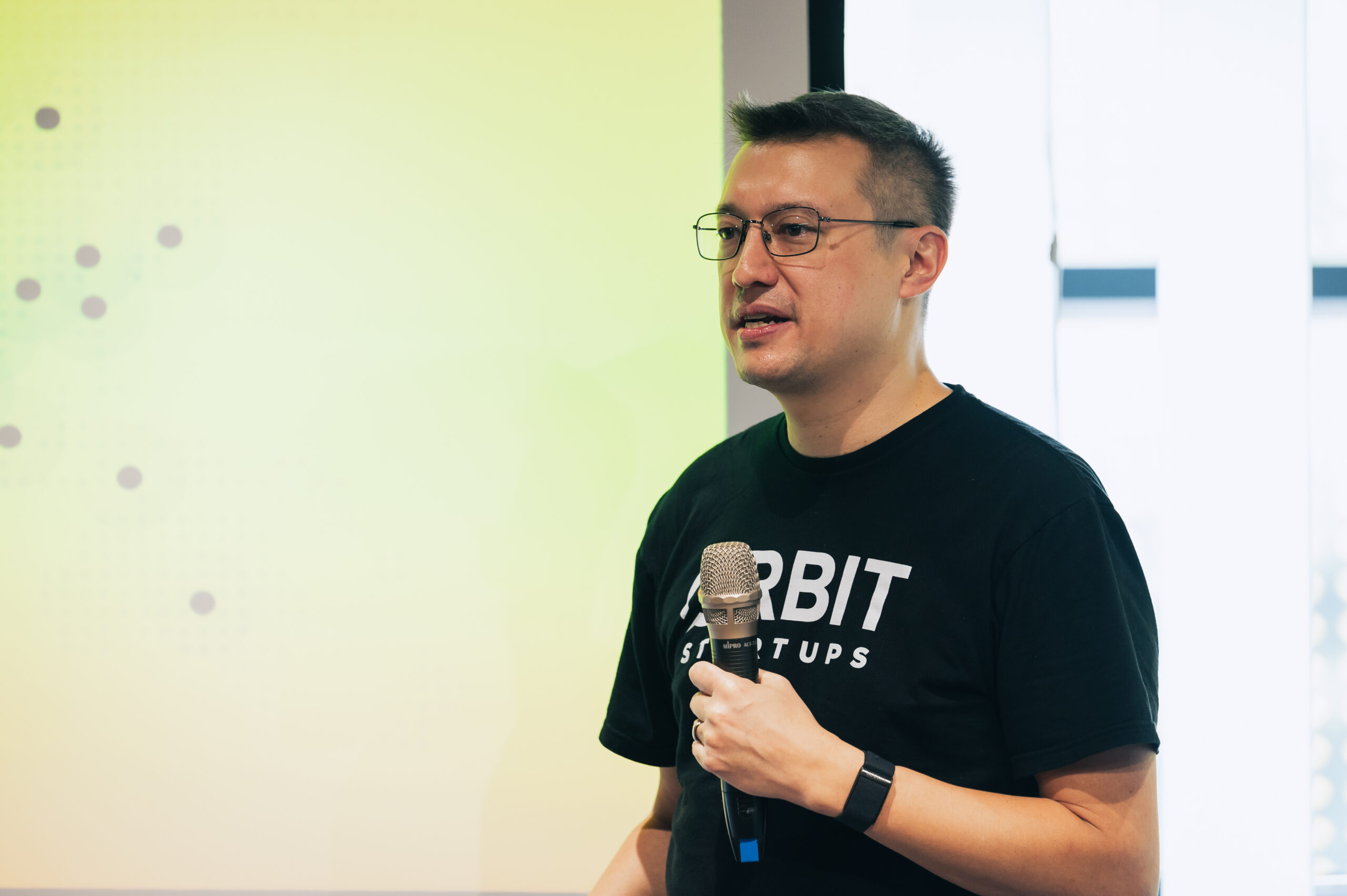
When Mike Narodovich was studying applied physics, his tendency to “keep breaking things in the lab” pivoted him from research to industry. That move put him on the front lines of the mobile boom, the mobile payments transition, and the seven-year emergence of connected cars at Ford. Now a physicist turned entrepreneur, he’s a Partner at Acacia Venture Capital Partners.
His session at the Orbit Growth Summit delivered a critical warning: most founders are fatally misinterpreting their own growth.
The uncomfortable truth? “Not all growth is good growth,” Mike stated. “Growth that isn’t cash-flow positive can be painful—you’re growing yourself into a corner.”
The “Going Viral” Fallacy
Every founder dreams of explosive, “hockey stick” growth. Mike shared the story of one company that had it: “4,000% growth year on year, huge word of mouth.” It was the perfect viral loop. The problem? “no revenue.”
This viral growth was burning cash “harder and faster than you might have planned.” The founding team was so focused on optimizing the product for engagement that they weren’t analyzing the business they were building. When they finally dug into the data, the reality hit. “we weren’t in the market that we all thought we were,” Mike recalled.
Their explosive growth wasn’t coming from the high-value US or European markets their financial model was built on. It was coming from South Asia, where monetization potential was “as low as 10% of what you can charge.”
“It turned out we were Quora,” Mike said—referencing the popular Q&A platform known for massive user engagement but a notoriously difficult path to monetization. They had confused user popularity with a sustainable business. “I had to decide as a founder what race I was running,” Mike explained. “Not all users are created equal.”
The consequence wasn’t just a simple pivot; it was a “doom loop.” The company’s runway vanished. By January, they were scrambling to build a new financial model. By February, a new pitch deck. By March, it was an “SOS cash” call. What should have been a triumphant Series A raise became a desperate seed extension that didn’t close until the end of May. That five-month crisis, triggered by “good” growth, nearly killed them.
The Transparency Mandate
For early-stage founders, especially those pre-revenue, there’s a tendency to pitch the vision and hide the messy details. This is a fatal mistake.
Mike described a “hot” AI company that had strong champions inside his fund, but “the other members of our investment committee weren’t” convinced. The company, sensing the hesitation, sent a reflective email: “my fears, we aren’t communicating our business… effectively… can you share… the backgrounds of the two folks… to help us refine our answers?” It was a good instinct, but it wasn’t enough to get them over the line.
He contrasted this with another company that succeeded by preempting this doubt with radical transparency.
“I do find that few companies demonstrate their customer traction with detailed funnel data,” Mike noted. This winning company shared a “public pipeline… updated in real time.”
This document wasn’t just a list of logos. It was a verifiable roadmap to revenue. It “provided the link in profile of the key contact,” the company size, and, most importantly, the exact status and gate. “Explain to me how you’re engaging with them,” Mike said, pointing to a key line item: “‘Will start our commercial relationship once we add Google Cloud.'”
This simple, verifiable milestone built massive trust. It proved the founders understood the mechanics of their business and gave the VCs a tangible way to measure progress. “It’s okay to be pre-revenue,” Mike stressed. “If you have these right pieces of data… it can definitely help push your company over the line.”
The “On Plan” Illusion
The second, more subtle trap is believing your plan is a shield. “A lot of us who are engineers like to just say I’m on track… I’m following my plan,” Mike said. He described a company doing just that: “revenues on track… set to grow.” The VC was happy, planning their “pro-rata investment” for the next round.
“Until the government comes knocking,” Mike warned.
A sudden regulatory change hit the company with a massive, unexpected bill: “‘We want three quarters of a million dollars from you… in four weeks… You grew too fast.'”
The game changed instantly. The company was no longer a growth story; it was a crisis. For a VC, the calculus is brutal. “We’re not funding growth” anymore; this is a rescue operation. Worse, it created a structural conflict for the fund itself.
“we’re in fund three, and this is a fund two investment,” Mike explained. “My opportunity cost is a new company.” He couldn’t justify to his new investors (Fund 3) using their money to rescue an old fund’s (Fund 2) investment, especially when he could be funding the next unfettered rocket ship. This is the cold reality of fund mechanics.
This led to Mike’s most critical warning: “not to confuse executing on plan with winning. Just because your offense is working doesn’t mean you stop playing defense.”
Growth by Analogy
So, what do you do if you’re too early for any of these metrics? “What do we do at the starting line? You’ve got no metrics,” Mike acknowledged.
The answer is to prove your case using “analogous structure.”
“I’m looking for… similar businesses or models that might exist in the market, hopefully something I’ve participated in with my portfolio,” Mike explained. This is a direct cue to founders: do your homework. Read the VC’s portfolio.
He shared a perfect example: a Fund 3 pitch that was an analog to a massive, well-known success from their Fund 1. These founders didn’t just point to the old company. “they got the CEO of that Fund 1 company to invest at a seed stage.”
That CEO came to Mike and told him, “this is the company I actually wanted to build… because the AI now allows it.”
Mike’s reaction? “That’s pretty much an automatic check.” They de-risked the entire investment by leveraging the VC’s own history and network.
The Road Ahead
Ultimately, Mike’s session was a call for founders to adopt a more holistic, and brutally honest, view of growth. The numbers on your dashboard are only half the story.
The real story—the one VCs invest in—is qualitative. It’s about your team’s ability to adapt and your preparedness for the inevitable shocks. “Your growth story is as much about qualitative team dynamics as it is about quantitative metrics,” Mike said.
He asks one key question of every team: “Can this team… handle the 3x problem?” He defines this as the startup reality: “Typically, your journey will be three times longer than you thought. It’ll be three times harder and it’ll be three times as expensive.”
Sustainable growth isn’t just about building a great offense; it’s about having a defense—and the team—that ensures you’re still on the field to play.
—
Mike Narodovich is a Partner at Acacia Venture Capital Partners, an early-stage venture fund.
Orbit Growth Summit is where Orbit founders learn growth tactics from top experts in product-led growth, performance marketing, and scalable systems.