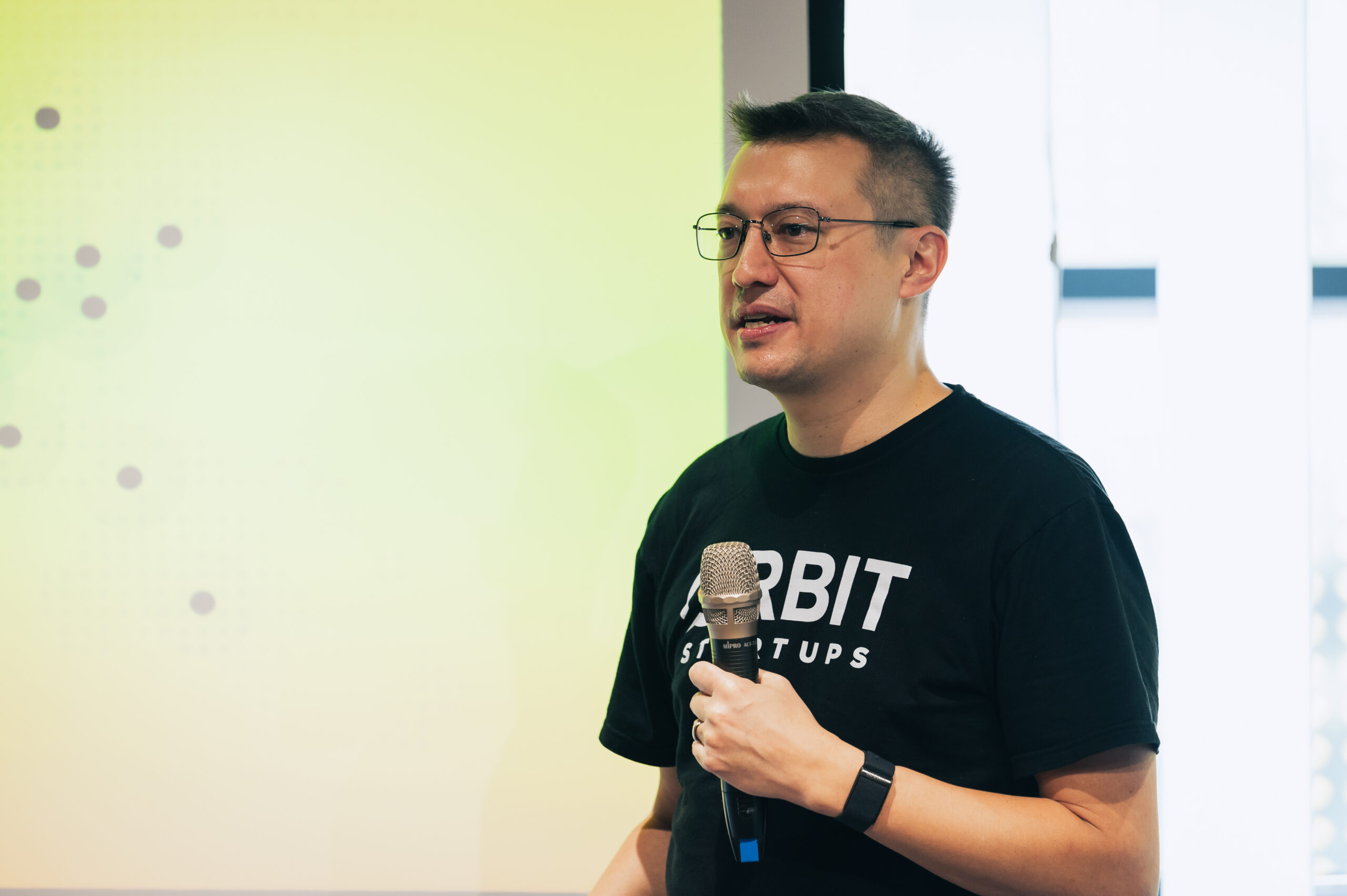
AI companies are raising at roughly 50% higher valuations compared to non-AI peers. According to Carta data presented at Orbit Startups’ ninth Demo Day, median pre-money valuations at seed stage reached $18.9M for AI companies versus $12.7M for non-AI companies in Q2 2024.
But – when asked to describe AI in one word, The VC panel at Orbit 9 Demo Day with William Bao Bean (Orbit Ventures), Sonia Gokhale (VentureSouq), Vikram Dhingra (Unbound), moderated by Peji Kanani (Carta): “bubble,” “overwhelming,” and “revenue.”
“There’s technology and then there’s a list of problems,” William Bao Bean explained. “The list of problems usually stays the same. What changes is the technology. In terms of the technology with AI solving the problems, there’s a lot of opportunity, but it’s not actually being realized yet.”
Sonia Gokhale emphasized the pace of change: “Literally by the week it’s evolving. We’re still very early.” But she acknowledged the flip side: “The hype is real. You are seeing insane valuations in AI, and that’s because people just don’t want to miss the boat.”
The hardware layer remains particularly underdeveloped. Vikram Dhingra pointed to DeepSeek’s optimization work: “We saw with DeepSeek how much value can be extracted just by optimizing the way you’re creating GPU clusters. That part of the ecosystem is still untouched.”
The Valuation Reality Check
Gokhale shared an anecdote from London. A global VC firm closed a $200M seed round remarkably quickly, bypassing the usual investment committee process. “It was moving so fast they didn’t even go to IC. They had to sign on the spot,” she explained. The story illustrates how intense AI market dynamics are globally—and why regional VCs take a more measured approach.
Regional VCs operate differently. “We don’t really have the luxury of playing with the hype because our investment is a set amount and our valuation range is basically a set amount,” Bean explained. For firms providing hands-on support, the question becomes whether founders want operational help or just capital.
The 2021 scars still influence decisions. “The memories of the 2021 cycle are still very fresh in my mind,” Dhingra said. “Any founders who raised capital and had to go through restructuring during that cycle are very hesitant to raise at such lofty valuations.”
Data confirms this caution: more than 20% of current rounds are down rounds, and the distortion extends beyond private markets. Barring the top 10 AI beneficiaries, the rest of the U.S. stock market hasn’t performed well on a growth-adjusted basis.
What Actually Gets Funded
Across these investors’ portfolios, a clear pattern emerges: specific problems, measurable outcomes.
- Unbound backed Whalebone, a Czech cybersecurity company distributing through telecom providers. The thesis: if capital floods into AI, significant risk emerges. App-based security often fails because users don’t update apps frequently. Whalebone’s telecom distribution solves this, already working with 50 operators targeting 1 billion protected users.
- VentureSouq invested in Mozn, a Saudi AML compliance platform built on local language, local data, and local regulations. They also backed Orbii, providing credit solutions using AI analysis of local data. “We’re investing in AI companies that are hyper-localized here, and they can grow very fast,” Gokhale said.
- Orbit Ventures funded Elevatix (Orbit 2025), a Dubai company building a plugin for online games that optimizes in-game purchase displays. “You basically plug this thing in, and it increases revenue by 15–20%. That’s it. Done,” Bean said. Not “AI-powered platform for X,” but “increases revenue by 20%” or “protects 1 billion users”—a problem-first approach to value creation.
Practical Advice for Founders
Solve an actual problem
Dhingra highlighted a common mistake: “It’s feeling as if we are slapping AI as a solution to all the problems we are seeing rather than getting excited about the problems and then figuring out if it’s an AI-native problem or not.”
This distinction matters for all founders. The panel’s advice wasn’t “become an AI company”—it was “use AI strategically to solve real problems.”
Eat your own dogfood
Sonia Gokhale was direct: “To the extent possible you should be using it internally. You can use AI just to reduce your burn, which is huge. I would equate it to back in the day writing letters and not using email. You should be using it.”
Dhingra emphasized prototyping efficiency with tools like Lovable and Cursor, but added two critical points:
- Don’t lose momentum: “Cycles come and go. It’s all about embracing change and staying relevant. But don’t get distracted because you don’t want to change your entire business and just in six months the whole cycle gets killed.”
- Follow the budget: “Evaluate where the budgets of your customers are going. Enterprises set budgets early in the year. If you’re mid-cycle, no matter how hard you push, you won’t unlock additional budget. Many SaaS founders lose momentum, and regaining it is the hardest part.”
William shared an example from Orbit’s Lean Startup Machine: a founder running a student transportation platform in Egypt used no-code AI tools to build a test product in 20 minutes. “Then he started using it for his own company, and the next week he had dashboards and a feature where parents could track their kids on a map. He just rolled it out to all parents in Egypt. The guy’s head exploded.”
Where the Returns Come From
Technology will continue advancing, and applications will proliferate. Yet the current valuation environment creates a dangerous dynamic: companies must deliver outsized outcomes to justify pricing, while investors feel compelled to pay high prices to avoid missing opportunities.
Companies that raised at peak valuations will face tough conversations. Down rounds will continue. But underneath the noise, real companies solving real problems will build sustainable businesses: a Czech cybersecurity company protecting a billion consumers, a Saudi compliance platform understanding Arabic nuances, a Dubai gaming plugin measurably increasing revenue.
Bean’s focus on revenue isn’t just an investment thesis—it’s a reminder that technology cycles come and go, but business fundamentals remain constant. The interesting part of AI isn’t the models, infrastructure, or billion-dollar rounds. It’s watching founders figure out which specific problems this technology solves—and building businesses that capture value at rational prices.
That’s where returns come from—not from riding the hype, but from finding signal in the noise.